
Houghton County Deed Types
The Register of Deeds files conveyances and much more. Some recorded instruments affect land without transferring it. Read the label and text of every document. A deed may convey a whole parcel, a partial interest, or a newly divided tract. A mortgage secures a debt, a lien asserts a claim, and neither makes the lender or claimant the owner of record just because a name appears in the same deed index.
| Instrument | What it does | Typical trail |
|---|---|---|
| Warranty deed | Conveys the stated interest with title promises | Purchase and sale |
| Quitclaim deed | Conveys whatever interest the grantor holds | Family or title cleanup |
| Personal representative deed | Conveys through an authorized estate representative | Probate sale |
| Sheriff or tax deed | Records a transfer after a legal process | Foreclosure or tax proceeding |
| Corrective deed | Corrects stated terms in an earlier deed | Name or description correction |
A public auction notice is not a deed. Follow any foreclosure or auction lead through the final order and disposition to the recorded conveyance before treating ownership as changed.
Houghton Register of Deeds Office
The Register of Deeds occupies the first floor of the Houghton County Courthouse at 401 E. Houghton Avenue in Houghton. The phone number is 906-482-1311. Public hours run Monday through Friday, 8:00 a.m. to 4:30 p.m. Papers must reach the office by 3:30 p.m. for same-day recording. The courthouse terminal offers free index searching. Remote users can search through Tapestry, mail a focused request, call about retrieval, or visit the counter. The office route matters most when an image fails. Certification also calls for a visit, and so does an older deed that falls outside remote coverage. The official Register of Deeds page lists current contact details, hours, fees, and the fraud-alert link. Check there before any order.
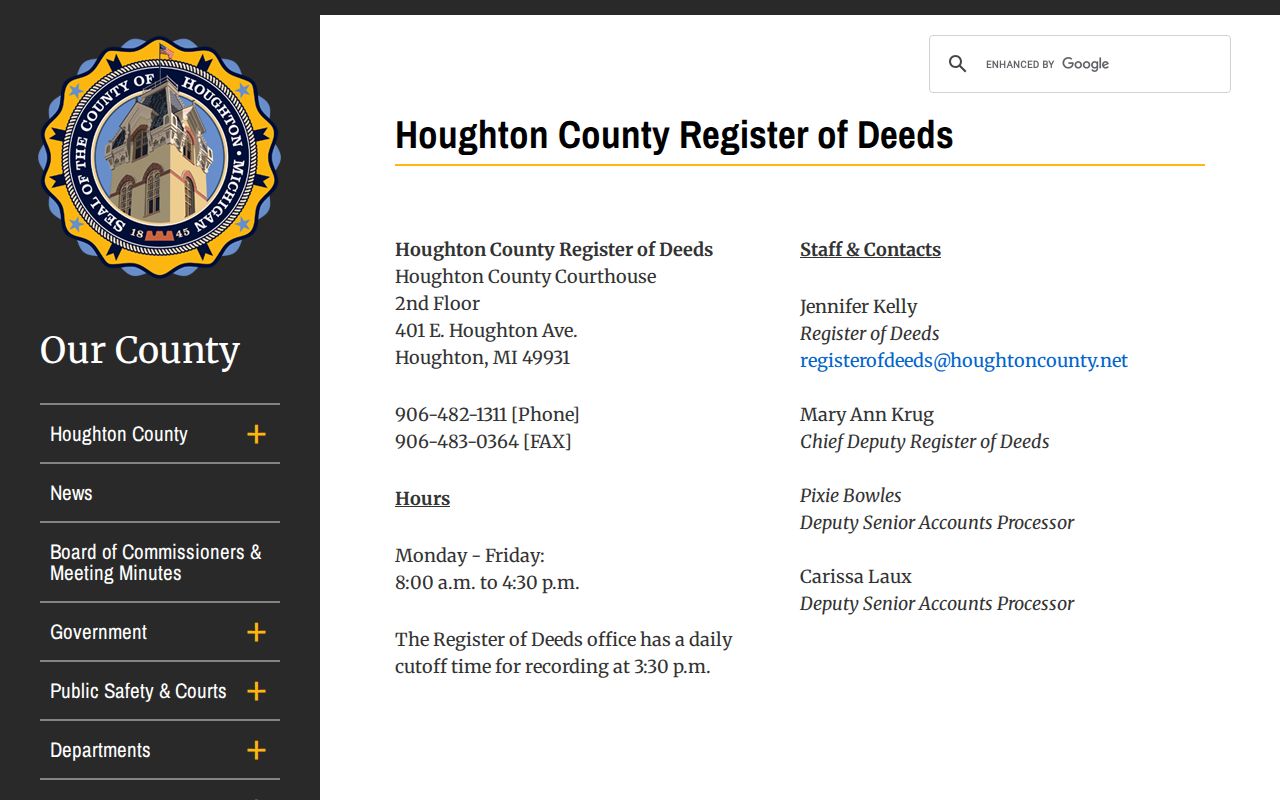
The office page lists current access and copy charges first.
Filter Houghton County Deed Records
Direct Search goes well beyond a party name. Name fields cover business or last name, first name, and middle name. Date controls handle both document and recorded dates. Document filters include group, type, and status. Geography narrows by municipality, section, township, range, quarter, quarter-quarter, tract, subdivision, block, and lot, while situs filters cover house number, street, city, and ZIP.
| Filter family | Fields | Best use |
|---|---|---|
| Party | Last or business, first, middle | Grantor-grantee search |
| Date and type | Document date, recorded date, group, type, status | Narrow a known event |
| Geography | Municipality, PLSS, subdivision, block, lot | Follow the land description |
| Identifier | Parcel, book, page, reference | Retrieve a known instrument |
A result can report document number and type, document and recorded dates, and three party slots. Consideration, reference, book/page, and image availability also appear. Each entry gives several handles for cross-checking a deed record.
Read Houghton Recording References
The document date and the recorded date serve different purposes. A document date usually reflects signing. The recorded date shows when the office accepted the instrument into the public record. A gap between the two can matter when ordering copies or building a timeline. It does not settle legal priority on its own.
- Grantor
- The party transferring an interest.
- Grantee
- The party receiving an interest.
- Book and page
- A traditional location reference for a recorded instrument.
- Reference number
- An index key assigned to a filing.
- Consideration
- An amount or stated value connected with the conveyance, not necessarily current market value.
Save every reference exactly as written. A later corrective deed, discharge, assignment, or partial conveyance may cite that reference and explain why two index entries seem to conflict.
Walk Houghton Deeds Backward
Start with the latest verified acquisition deed. Open the document. Note the grantor, legal description, dates, and reference. Then search that grantor as a prior grantee, repeating while the description stays continuous.
- Confirm the subject parcel and its legal description on the assessment record.
- Find the current owner's acquisition deed and read the actual image.
- Carry the prior owner, plat or PLSS description, and references into the next search.
- Investigate corrective deeds, estate instruments, lot splits, and partial interests.
- Move to courthouse books and archives before the online coverage date.
Name-only chaining is unsafe. A common surname may pull in unrelated land, and a trust, estate, spouse, or company can break a simple personal-name trail, so the land description remains the thread.
Online Houghton Deeds Start in 1993
Deeds recorded in Houghton County reach back far earlier than the internet. Remote access through Tapestry begins with instruments from September 1993. Anything older lives in courthouse books, microfilm, patents, assessment rolls, or archived holdings. A full chain of ownership often has to cross both systems. Records from before 1993 are simply a counter or archive task, not a dead end.
Costs differ depending on how you work. Remote Tapestry/Land Records searches run $8.75 each, with $1 per page to view or print. At the courthouse, public terminal index searches cost nothing. Office copies are listed at $1 per page. Certification runs $5 per document, and assisted searches cost $5 per name or description per year. Confirm current fees before ordering anything.
The Tapestry landing page displays the remote land-record system.

The paid remote option complements free counter access and office retrieval of older material.
Historic Plats Preserve Houghton Land
Old wording outlives changes in government and addressing. "Village now City" is a useful local clue. Supervisor's Plat of East Houghton appears in recent planning material at Liber 2 of Plats, Page 32. Hancock files preserve Condon's Third Addition and village-era lot splits. Even when a current address is known, search the original plat, block, and lot.
Houghton County was created in 1845 from territory tied to Marquette, Schoolcraft, and Ontonagon. It once included land later assigned to Keweenaw and Baraga counties. The county seat moved from Eagle River to the Village of Houghton in 1861. These shifts can redirect an early land search. They do not mean records were destroyed.
Archives of Michigan finding aids point to Houghton land patents, assessment surveys from 1937 through 1973, early court files, and other land series. Use them alongside county deeds. They supplement, never replace, the recorded chain.
Order a Houghton County Deed
Gather a few details before you order. The document or reference number, book and page, party names, recording date, municipality, and legal description all help the Register of Deeds locate the right deed record fast. An online image works fine for casual reading. When a recipient needs an official reproduction, request a certified copy from the office instead.
Fees are straightforward. Standard recording runs $30, which includes the Michigan Remonumentation and Register of Deeds Automation Fund charges. A tax certificate costs $5. Copy fees sit apart from recording requirements and transfer-tax paperwork. Under MCL 207.521 et seq., the seller, or grantor, generally pays Michigan transfer tax on a taxable conveyance of real property.
Recorded, not guaranteed. The index shows filed instruments, not a title opinion. Unrecorded interests and survey issues can still exist.
Estate Deeds in Houghton County
Estate paperwork often inserts an unfamiliar name between two familiar ones. An estate, a trust, or a personal representative may hold title during a transition. A surviving owner may hold it too. Begin with the deed index. Then turn to Houghton County Probate and Family Court when an estate administration or court order explains the parcel transfer. A death certificate proves that someone died. It does not convey the land.
A focused request to the court can seek a case number or a public inventory. It can also seek letters of authority, an order approving sale or distribution, and the later recorded instrument reference. Keep in mind that some court files are sealed or redacted. Whatever you obtain, match each estate document to the parcel number. Match it to the legal description too before drawing conclusions.
Monitor New Houghton Deed Filings
Houghton County offers a free Property Fraud Alert service worth enrolling in. It works on exact-name matching. Choose email notice, telephone notice, or both. When a matching indexed name appears in a new deed filing, the alert tells you, though it cannot block a filing, judge whether fraud occurred, or substitute for reading the document itself. The official enrollment flow displays the name and delivery choices.
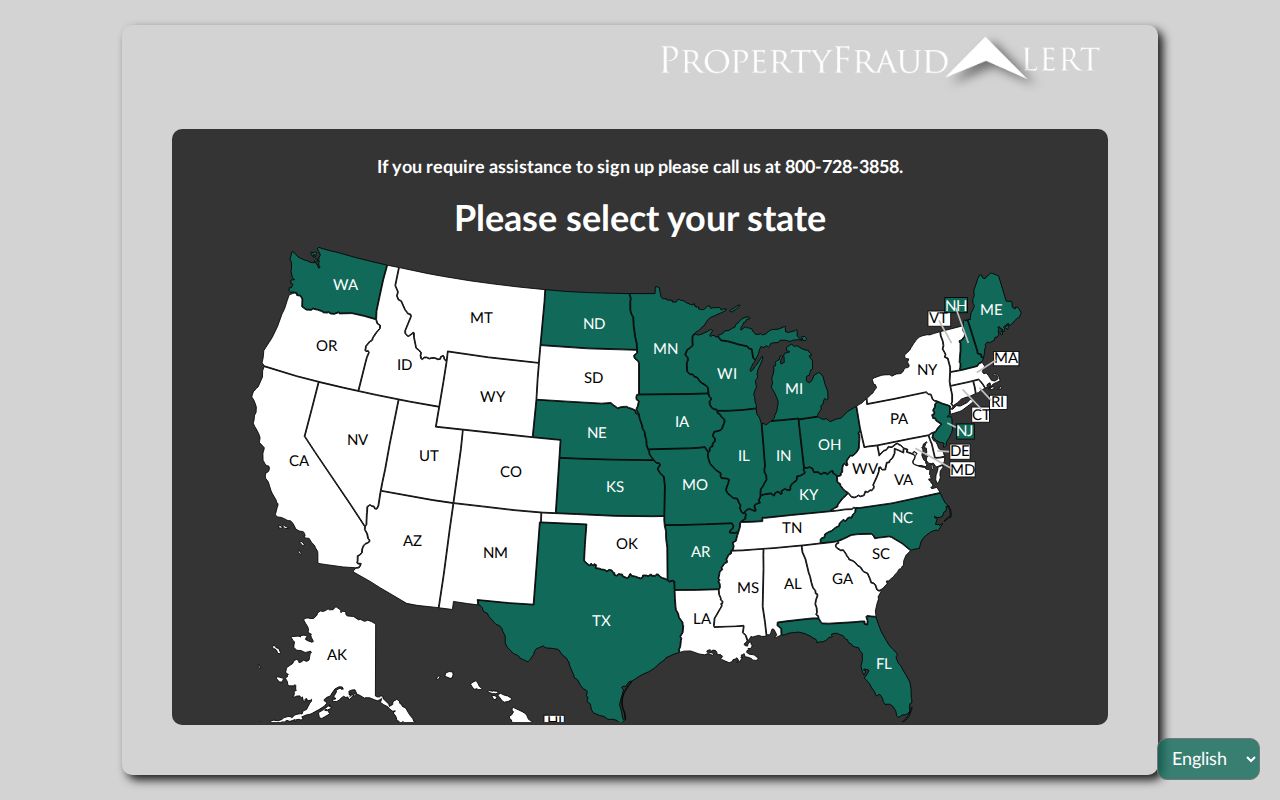
Enroll every name form that appears on your recorded deeds. If an unfamiliar notice arrives, contact the Register of Deeds promptly about the deed record behind it.
Lawful use. Use deed records for legitimate land research and due diligence. Never use owner or address details to stalk, threaten, or harass.