
Identify a Houghton County Owner
A short record trail answers who owns a Houghton County parcel best. The county-linked BS&A entry accepts owner, address, and parcel-number searches. A parcel card makes a strong lead. It joins the current owner or owner of record to the situs, mailing address, parcel number, legal description, sale data, and assessment fields. Copy the parcel number exactly. It is the stable key. That key moves a searcher from a tax record to a map. It also reaches a recorded instrument with nothing lost.
- Enter the situs address in BS&A. Try the street without a ZIP or unit detail if the first search fails.
- Copy the parcel number, current owner name, mailing address, municipality, and legal description from the matching card.
- Search Houghton County Direct Search by parcel number and owner name. Locate the latest conveyance.
- Compare its grantee and legal description with the parcel card. Ask the Register of Deeds for the image or certified record when proof matters.
A fresh deed can reach the recorder before the assessment roll refreshes. Note both dates if the names differ. Each office keeping a record can explain its lag, and the general current-owner record check centers on that present-tense comparison.
Houghton County Parcel Card Clues
The assessment record adds context a name alone cannot supply. Owner and mailing fields show where tax mail goes. The situs is the location taxed. The two need not match. A seasonal owner, business, trust, or estate may get mail outside Houghton County while the land sits inside it. Never swap situs for mailing address in a search.
The live parcel card reveals its labels and refresh date only after a query runs. The county names BS&A and Equalization as access points. City assessors keep their own rolls. Treat the name as the current owner or owner of record until the responsible assessor says more. A parcel number plus a full legal description beats a name match for certainty. Open the official BS&A starting screen before choosing a search mode.
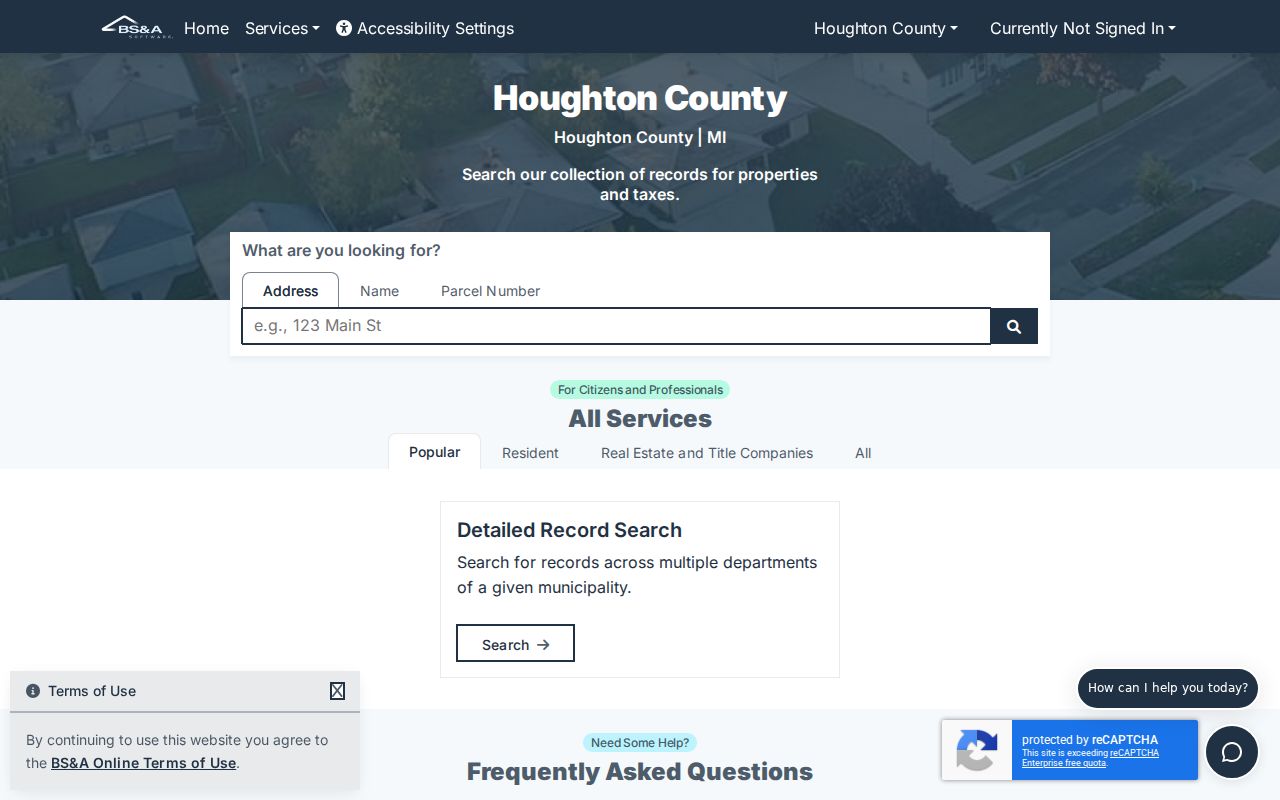
The county-branded entry confirms the route. A live parcel result and a recorded deed still carry the actual ownership answer.
Confirm Ownership in Deed Records
The Register of Deeds holds the recorded instruments that show how the named grantee acquired an interest. Direct Search filters by first name, last or business name, date, document type, subdivision, lot and block, municipality, tract, street address, parcel number, book and page, or reference number. Results vary. A record may list document number and type, recorded and document dates, parties, book and page, consideration, and an image action. Not every instrument carries every field.
Use the parcel number first. Then use the exact owner name. Open the newest deed that matches the same legal description. The grantee receives the interest. The grantor transfers it. Recording is strong evidence of the public chain, but an index is not a title opinion. For a purchase, estate, or boundary dispute with real stakes, obtain the recorded image and seek qualified title help.
Ownership Terms in Houghton County
A few definitions keep a Houghton County owner search clean. One trail may use every term below.
- Owner of record
- The owner name carried on the current assessment roll, subject to update lag.
- Grantee
- The person or entity receiving the interest in a recorded deed.
- Title
- The legal rights in the property, which a portal summary does not fully prove.
- Situs address
- The physical location of the parcel, distinct from the owner’s mailing address.
- Parcel number
- The tax and mapping identifier used to match records across county systems.
Names change format between sources. A matching parcel number and legal description tie each record to the same ground.
Houghton County Ownership Sources
Houghton County sources split the ownership question. Each one answers a different part of who owns this property, so read results together and label the date and keeper of each.
| Where Ownership Appears | What It Gives | How Current |
|---|---|---|
| BS&A assessment roll | Owner or owner of record, mail address, situs, parcel and value context | Current roll, but exact Houghton refresh timing is unverified |
| Register of Deeds index | Grantor, grantee, recorded date, deed reference and legal description | Newest recorded conveyance is the key confirmation |
| Beacon parcel map | Parcel location and a route to related property data | Map date should be saved if displayed |
| Probate or court file | Orders or estate papers that explain a transfer | Depends on case status, access, and redactions |
The roll names a tax-record owner, not an occupant. The deed records a conveyance. A court decides disputes, and no single field reveals every beneficial interest or who lives at the land.
Houghton Trusts and Estate Owners
A Houghton County property owner may appear as a trust, estate, personal representative, survivor, or business entity. Search the exact entity text from the card. Then try name variations in Direct Search. Keep the parcel and legal description fixed so a same-name result does not pull the wrong land. An entity filing can identify a business agent, yet it does not prove the entity owns the parcel.
Estates add a court layer. The Houghton County Probate and Family Court may hold letters of authority or an order approving a sale or distribution. Those papers explain the path, but the later instrument recorded with the Register of Deeds shows the public conveyance. Death certificates and obituaries help fix dates. They do not transfer title.
Houghton County Records Move Differently
Records in Houghton County update on separate clocks. The deed index, tax roll, and parcel cards each follow their own schedule. A mailing address can change with no new deed. A split can even create a new parcel number. Title still traces through an older legal description. Date every result.
If online access fails, call the office. Equalization sits on the courthouse fourth floor. It provides parcel cards, reports, mapping links, and a data-sharing route. The Register of Deeds works from the second floor. It records on weekdays, with a daily cutoff before close. A narrow Michigan FOIA request can reach non-exempt county records, but the limits are real. No office must create a title opinion or merge separate systems for a requester.
Note: A portal outage is an access gap. It is not proof that a Houghton County property has no owner record.
Protected Houghton Mailing Addresses
Michigan's Address Confidentiality Program gives eligible participants a designated address with mail forwarding. A safety reason can sit behind a mismatch. The mismatch is between the owner mailing address and the parcel situs. Never use land records to uncover a protected physical address.
Law, court order, or program rule can also suppress public fields. A redacted name does not erase a recorded interest. It only limits what a portal should show. Ask the custodian about lawful access. Do not try to rebuild private location data from several sources.
Limits of Houghton Owner Lookups
An assessment name answers less than it seems. It does not show who occupies the land, what rights attach, or whether an unrecorded claim exists. Easements can hide inside the deed. Reservations and legal wording often live in the recorded document rather than the index. Trusts and companies add another layer. They can separate the named owner of record from the people who manage or benefit from the property, so answering who owns this property for routine research differs from certifying marketable title.
Use records lawfully. An owner lookup supports purchase research, boundary questions, estate work, and civic review. Never use owner information to stalk, harass, intimidate, or harm anyone.
A solid Houghton County owner conclusion names its source, date, parcel, and limits. Naming the match's limits keeps the conclusion honest. That brief citation lets anyone verify the same official record.
Older ownership needs a different route. Tapestry's online span begins in September 1993. Earlier years move to the Register's books, office help, and state finding aids. The separate previous-owner trail follows that backward chain. It does so without confusing it with the current owner.
Keep an evidence log. Record the situs, parcel number, legal description, roll date, deed date, and recorder reference. The log shows whether an answer rests on a current assessment name. It may also rest on a recorded conveyance, or both. A mailing-address change is not a new owner. When records conflict, save both entries and ask each custodian about its update date.