
Three Meanings of Houghton County Property Value
Michigan's assessment system produces figures for tax administration. Recorded conveyances, by contrast, preserve evidence of actual transactions. Match the parcel and the effective year before comparing any two numbers. A recent sale can still differ from the assessor's mass-appraisal conclusion for Houghton County property records.
| Value | What It Is | Where |
|---|---|---|
| Assessed value and SEV | Tax assessment measures tied to Michigan's 50% true-cash-value framework | City or township assessment roll |
| Market or true cash value | The assessor's mass-appraisal view of full value | Assessment methodology and notices |
| Taxable value | The capped base used in the property-tax calculation | Assessment and tax record |
| Last sale or consideration | A past transaction figure, which may not be an open-market price | Recorded deed or transfer record |
Michigan assesses property at 50% of true cash value. Taxable value can sit below assessed value because annual growth stays capped until a transfer uncaps it the following year. Two similar Houghton County parcels can therefore carry very different taxable values on the same tax roll.
Michigan's 50 Percent Rule Shapes Houghton County Values
Michigan law sets assessed value at half of true cash value. State equalized value, or SEV, adds equalization adjustments that keep assessment levels consistent across jurisdictions. Double an SEV and you have the system's implied true cash value. That is still not a promise of a sale price.
Mass appraisal groups many properties and applies common market evidence. A private appraisal studies one property for a stated date and purpose. Condition, access, shoreline features, improvements, and transaction terms can all pull an actual sale away from the public figure in Houghton County property records.
Taxable Value Can Trail Houghton County Assessed Value
Michigan taxable value is a separate animal. Its annual growth is generally capped. A transfer can uncap it the next year. Principal residence status can shift the tax burden without changing what the land and improvements are worth on the assessment roll.
A lower taxable value is not a market discount. It describes the tax base Michigan's system produces. The property tax records guide covers bills, exemptions, and appeals. This page stays with what the value fields mean in Houghton County property records.
Houghton and Hancock Land Tables Add Local Context
The City of Houghton assessor page links 2025 land tables and economic condition factor material. For a city parcel, ask which table and ECF apply. Then compare those inputs with the assessment card. The city assessor also prepares regular and special assessment rolls. The office assesses taxable city property each year.
Hancock's 2025 land table offers a different view. Its fields include sale date, sale price, and adjusted sale. They also list assessment at sale, residual land, frontage, and dollars per front foot. Those columns help explain neighborhood valuation work across Houghton County. The table is not a current parcel appraisal or recorded deed, though.
A Hancock Example of Houghton County Value Access
The Hancock BS&A search shows how name, address, and parcel-number routes each lead into municipal tax and assessment information for a Houghton County parcel.
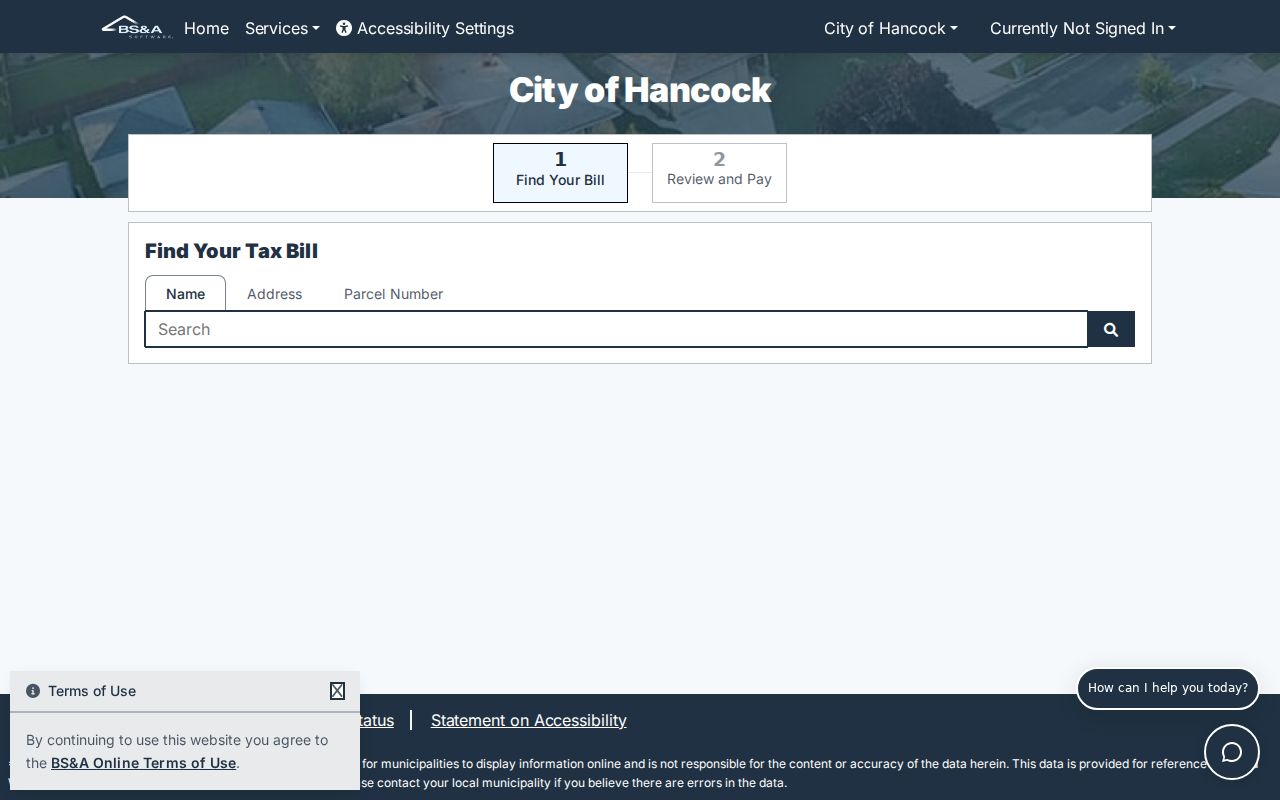
The official search page displays its lookup fields rather than full countywide value detail. Confirm the parcel, municipality, assessment year, and value labels before comparing records.
Look Up a Houghton County Property Value
Use the county-linked BS&A entry or the local assessing unit's roll. An address is only a starting clue. The parcel number is the better key for carrying a Houghton County property search from one office to another.
- Search the address at the county-linked BS&A entry and confirm the municipality.
- Save the parcel number, assessed value, SEV, taxable value, and assessment year exactly as labeled.
- Request the card or value history if land, improvement, exemption, or prior-year detail is absent online.
- Check Direct Search or Tapestry for the deed and consideration when a past sale is relevant.
- Assessed value
- A tax assessment measure, distinct from taxable value.
- Market or true cash value
- The assessor's full-value estimate within the mass-appraisal system.
- Assessment ratio
- The relationship between assessed and true cash value. Michigan uses a 50% framework.
- Reassessment
- A new determination of value for an assessment year, not a new sale.
Request Houghton County Value History When Screens Are Thin
The county data-sharing schedule lists digital or old-paper record cards at $2 each, or $5 with a sketch. It also lists assessment rolls and other data products. Ask Equalization whether the card is current or historical. Name the years you need. Confirm the fee before ordering, since a published schedule can change.
A complete card preserves land and improvement components, assessed value, SEV, taxable value, exemptions, transfer information, and the year attached to each entry. An online summary may not expose every field. Request the record card when the screen looks thin.
Recorded Sales Need Context in Houghton County
A deed's consideration can be strong market evidence. Not every conveyance is an arm's-length sale, though. Family transfers, estate transactions, and quitclaims can make the recorded amount a poor comparison. Partial interests and unusual terms can have the same effect. Read the deed type and legal description before using the number.
Tapestry coverage begins in September 1993. Older sale and ownership evidence may require office indexes. It may also require deed books, microfilm, or archives at the Houghton County recorder. Keep the recording reference with the amount so another reader can verify the deed.
What Houghton County Property Value Cannot Prove
An assessment is a mass-appraisal figure for public administration. It can lag the market, miss a condition change, or rest on information that should be corrected. A sale price describes one past transaction, and neither figure alone settles a present purchase decision in Houghton County.
Value is not price. A Houghton County assessed value is not what a property will sell for, and it is not a parcel-specific appraisal.
When records conflict, keep each date and ask the office that owns the underlying record. A deed may post before the roll refreshes, and a parcel split can reach one system before another. Never just pick the newest-looking number from Houghton County property records.