
Houghton County Tax Record Fields
Every Houghton County tax search starts with the parcel number. That single number links the assessment card, the current bill, any delinquency history, and the parcel map. Names and mailing addresses on the account help confirm you have the right property. When a transfer is in question, though, the recorded deed controls.
| Field | Meaning | Keeper |
|---|---|---|
| Assessed value | One-half of estimated true cash value | Local assessor |
| SEV | Equalized assessed value | Assessment roll |
| Taxable value | Capped tax base | Assessment roll |
| PRE | Qualifying principal-residence school-tax exemption | Local assessor |
| Bill status | Paid, due, or delinquent amount | Local or county Treasurer |
Michigan Value Rules in Houghton
Michigan law assesses property at 50 percent of true cash value. Taxable value usually rises by the lesser of five percent or the inflation multiplier. A transfer changes that math. It typically uncaps taxable value the following calendar year. At that point the figure equals SEV, not the sale price.
- True cash value
- The assessor's market-value estimate.
- Assessed value
- One-half of true cash value.
- Taxable value
- The value to which millage is applied.
- Mill
- One dollar of tax per thousand dollars of taxable value.
Search a Houghton Tax Bill
Begin with the county's link to BS&A property records, where each parcel's number, municipality, assessed values, exemptions, and transfer history sit together. Jot down the parcel number before leaving. Then reach out to the city or township treasurer for the current-year tax bill. For delinquent taxes, the Houghton County Treasurer at 401 E. Houghton Avenue, 906-482-0560, can pull records and payment histories.
- Find the parcel by address and verify its legal description.
- Read assessment, SEV, taxable value, classification, and exemptions.
- Check current billing with the local treasurer.
- Check transferred delinquency and payment history with the county Treasurer.
The official county payment form displays the payment type, billing details, amount, service fee, and the bank or card sections for completing the transaction.
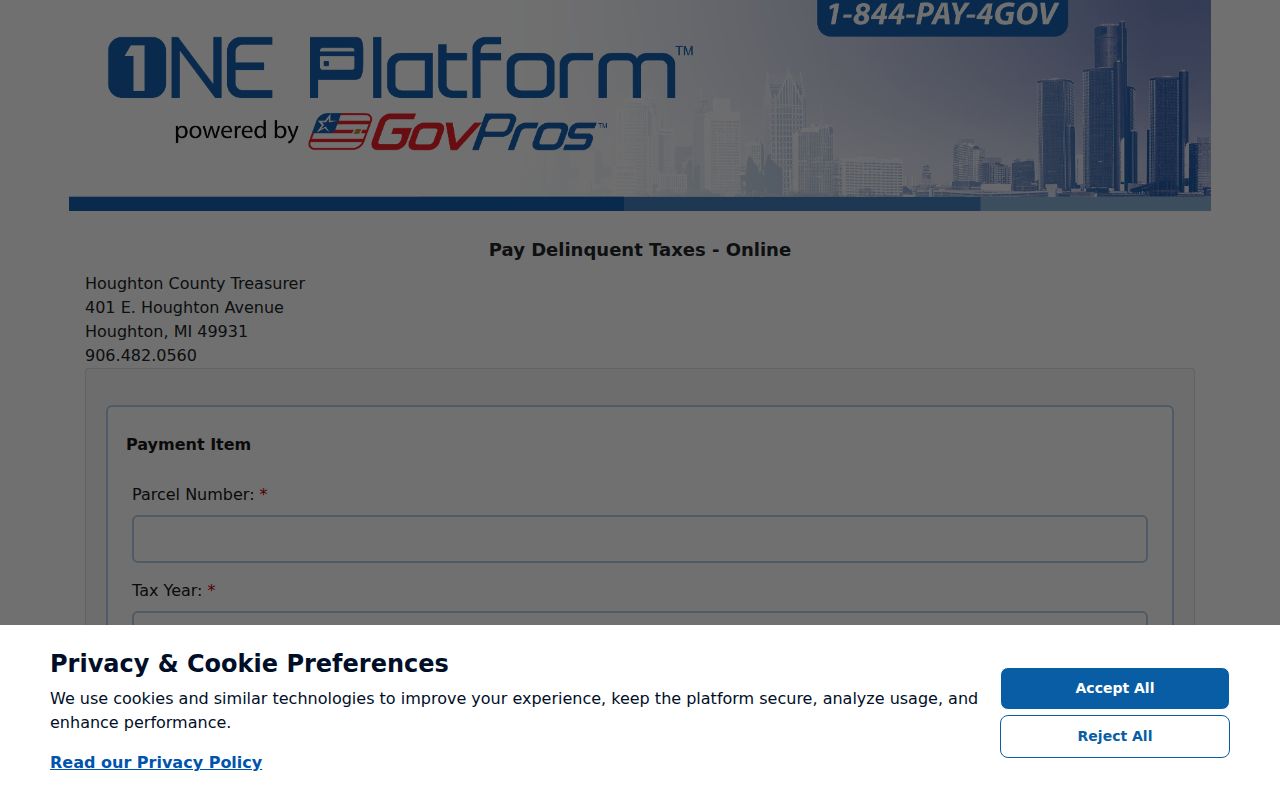
Read any service charge separately from the underlying tax balance.
Houghton City Tax Calendar
City of Houghton materials lay out a summer bill. It is issued in July and due in September. A winter bill follows. Unpaid amounts move to the county after March 1. Don't assume that schedule applies to every township. Each local treasurer sets dates for its own parcels. The Houghton Treasurer source documents the city's cycle in full.
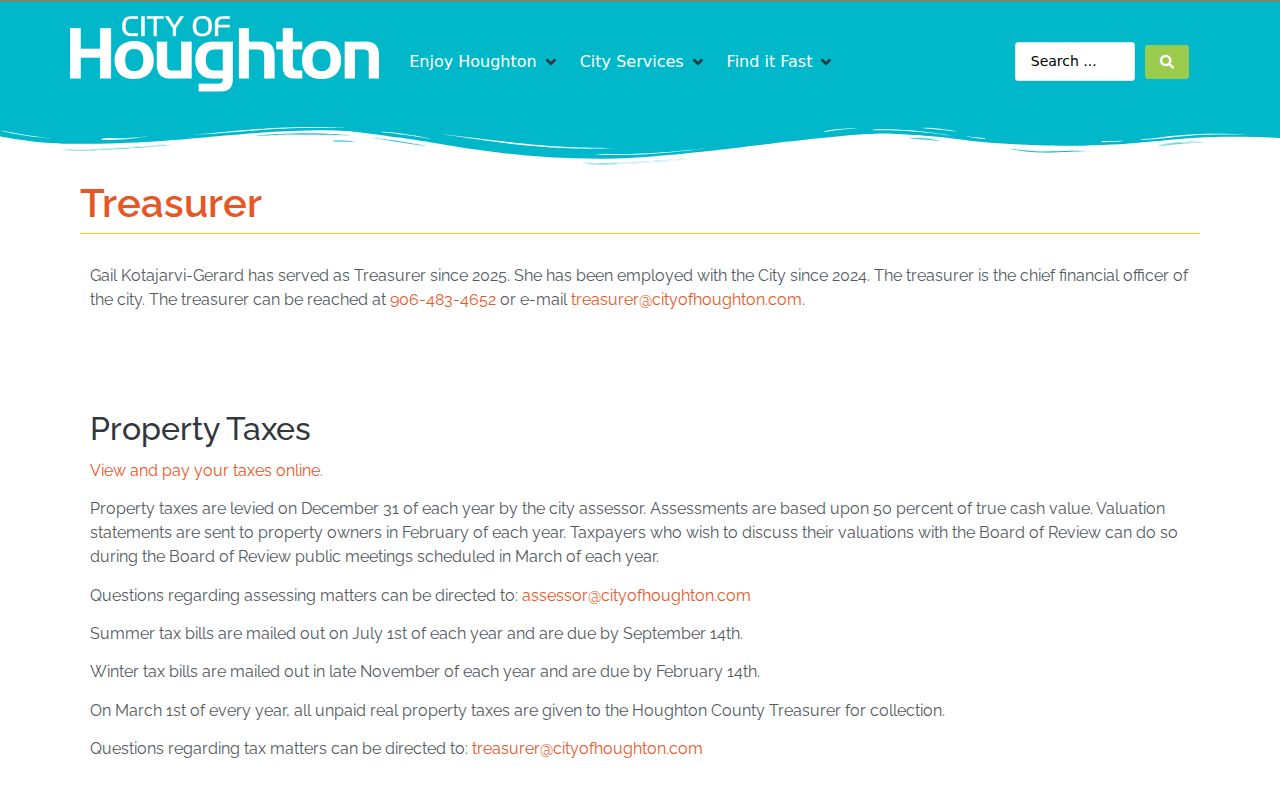
The city calendar also shows when an unpaid city account shifts into the county's delinquent-tax trail.
Houghton County Exemptions
The principal residence exemption can remove up to 18 mills of local school operating tax from a qualifying principal residence. Eligibility turns on ownership, occupancy, and a filed affidavit. A matching mailing address alone proves nothing. Agricultural and other exemptions carry their own evidence and filing standards.
Check the parcel card for any exemption first. Then confirm its status with the local assessor. A property transfer affidavit helps show whether an uncapping event occurred. Keep transfer-tax documents separate from the county recording fee and the tax bill; they are different records.
Appeal a Houghton Assessment
Michigan Board of Review form L-4035 asks for the owner and petitioner, municipality, parcel number, address or legal description, assessed value, estimated true cash value, classification, and the reasons behind a taxable-value protest. Strong evidence helps. It can include comparable sales, photos, repair estimates, surveys, or a factual correction to the record card.
Filing with the local Board of Review generally comes before any Michigan Tax Tribunal appeal, subject to statutory exceptions. State guidance sets later deadlines. These vary by property class. Houghton County publishes no confirmed 2026 local meeting calendar. Verify the filing date with the local assessor.
Deadline matters. Ask the local assessor for the current Board of Review schedule before relying on a statewide appeal date.
Request Houghton Tax Records
Equalization, at 906-482-0250, supplies assessment cards and roll information. The county fee schedule lists record cards at $2. A card with a sketch runs $5, plus $2 for parcel or plat copies. Bulk rolls and custom exports cost more, so ask for an itemized estimate.
A narrow Michigan Freedom of Information Act request should name the parcel. It should also list the address, municipality, tax year, desired record, format, and delivery method. Under MCL 15.231 et seq., the office generally has five business days to respond. It may take a ten-business-day extension.
Houghton County Classification
Michigan sorts real property into six classes: agricultural, commercial, industrial, residential, timber-cutover, and developmental. Classification describes use and affects appeal routes, but it is not zoning. Houghton County has no countywide zoning. Cities, townships, and villages control that. Equalization studies assessment levels across local units.
County materials describe more than 80 sales and appraisal studies each year. Those studies support equalization. They never replace the local assessor's parcel valuation. If a classification, size, improvement, or condition fact looks wrong, request the record card. Raise the specific error with the assessor.
Compare Houghton Value History
Read a parcel card as a set of dated fields rather than one number. Compare land and improvement components across years. Compare assessed value, SEV, taxable value, exemptions, and transfer history too. A gap between SEV and taxable value often reflects Michigan's cap. A transfer may trigger uncapping the next year. Construction, demolition, a split, or a factual correction can also shift the figures.
Remember that a sale price is evidence in assessment studies. Yet one sale does not automatically set taxable value. An online estimate is never an official assessment. Always preserve the tax year and valuation date when quoting a number. The Houghton County property value resource explains these distinctions further.
If the online card is unavailable, request the current card from Equalization. Ask for the full value history as well. Ask whether you need a plain lookup, a certified record, or a custom export.
Houghton Tax Liens and Courts
Unpaid property tax, mortgage foreclosure, construction liens, and federal tax liens. Each leaves a different paper trail in Houghton County. Start with the Treasurer for delinquent real-estate tax status. Then move to the Register of Deeds. That office records liens, assignments, discharges, deeds, and notices tied to a parcel. A judicial foreclosure or title fight may also surface in the MiCOURT case index and the 12th Circuit Court file. Check both when litigation seems likely.
Request the complaint, any lis pendens, the judgment, orders, and sale confirmation. Also ask for references to recorded documents. A lis pendens only warns that a lawsuit is pending. It says nothing about who won. Federal liens or bankruptcy can pull in the Western District of Michigan and PACER. Even so, federal access never substitutes for the county index. A recorded discharge is what clears title. Build a dated chronology of instruments. Resist the urge to lump every debt record under one generic tax-lien label.
Delinquent Houghton Property Tax
A delinquent account and a finished foreclosure are not the same thing. Treasurer status, a tax-sale listing, and a public auction notice mark three distinct stages. A winning bidder gains nothing until the required process runs its course. The deed or other disposition must also be recorded with the Register of Deeds.
One July 2026 IRS auction notice named two North Entry Road parcels. It also included minimum-bid details. Treat that notice as a lead, not as proof of any transfer. Search the parcel in the Treasurer and deed systems after the event to see what actually happened.
Verify the outcome. Never treat an auction listing as a current-owner record without a later official disposition and recorded deed.
Resolve Houghton Tax Conflicts
When two Houghton County records disagree, compare their "as of" dates first. A newly recorded deed may run ahead of the assessment roll. The roll itself may move faster than a tax portal that refreshes on its own schedule. Keep copies with retrieval dates for your file. Still, take the question back to the responsible office for confirmation.
Use the parcel number and legal description. That tells a real conflict from a simple mailing-name change. Ask the local assessor about value and exemptions. Ask the county Treasurer about transferred delinquency. Ask the Register of Deeds about the recorded conveyance itself. No single portal assembles a complete tax-and-title report. Expect to piece it together across offices.